
Hydrolite’s AEM membrane and electrodes had to meet two demands from the start: perform inside the electrolyzer and remain practical to manufacture at scale. Commercial materials, extrusion, and reinforcement shaped the four-year development process.
When Hydrolite began developing its own membrane technology, electrochemical performance was only part of the equation. The team also wanted to know whether the materials and manufacturing process could support larger membranes, higher production volumes, and eventually, commercial scale electrolyzers.
Hydrolite’s work in electrolysis also builds on expertise developed through years of research in fuel cell materials and manufacturing. Knowledge gained in areas such as catalyst development, electrode engineering and advanced production processes proved highly transferable, helping the company accelerate the development of high-performance electrolysis components without starting from scratch.
This experience also supports precise electrode manufacturing, flexibility in electrode design and the ability to scale production toward larger stacks at practical manufacturing rates.
Unconventional Methods, Easier Manufacturing
According to Charly Azra, PhD, Chief Technology Officer at Hydrolite, that combination of process control and material consistency also contributes to the durability the company is targeting in its electrochemical systems.
With that in hand, the membrane required a different solution. During its fuel cell work, Hydrolite found that suitable membranes were relatively specialized products, with limited sourcing options. The company therefore began developing its own material, initially at laboratory scale.
The first challenge was to formulate a membrane that could deliver the required ionic conductivity while remaining stable in the aggressive chemical environment inside an electrolyzer. Hydrolite, however, added another constraint from the outset: the basic materials had to be commercially available, obtainable in meaningful quantities, and relatively inexpensive.
“We did not want to develop a material in the lab and only later discovered that it was difficult or expensive to manufacture,” Azra says. “We started with commercial materials and modified them chemically to achieve the properties we needed.”
Taking Extrusion into Membrane Production
Azra describes the approach as essentially top-down. Rather than synthesizing an entirely new base material and subsequently working out how to scale it, Hydrolite began with established industrial materials and adapted their chemistry. The company has followed that path for roughly four years, moving from small laboratory samples to membranes with areas of around 1,000 cm².
Material selection was only part of the process. Hydrolite also chose an unconventional manufacturing method: extrusion.
In a conventional membrane production process, the ion-conducting polymer is typically synthesized using wet chemistry, followed by purification and drying. It is then dissolved in a solvent and coated onto a carrier or reinforcement structure before another drying stage produces the finished membrane. The process can also be implemented in roll-to-roll production, but it still relies on the large quantities of solvents.
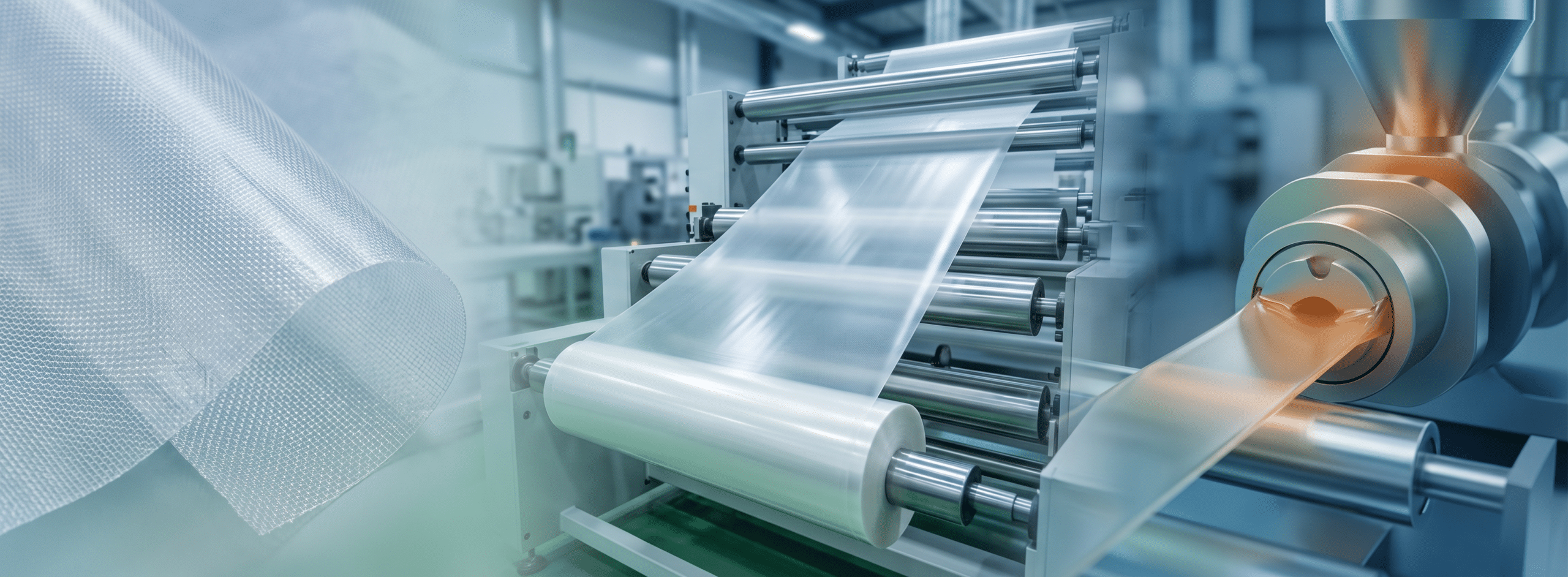
Hydrolite instead adapted extrusion, a process widely used in plastics manufacturing. The material is processed directly into membrane form without the conventional solvent-based coating and drying sequence. The advantage is straightforward: extrusion is an established high-throughput industrial process that works with conventional raw materials and provides a clearer path toward faster production.
Choosing that route also meant that many established membrane manufacturing solutions were no longer directly applicable. The team encountered technical questions for which it could not simply turn to published methods, forcing it to develop its own solutions around the extrusion process.
“Working differently created challenges, and in some cases it slowed development because there was no ready-made answer in the literature,” Azra says. “But that also led us to solutions that we probably would not have developed if we had followed the conventional route.”
A Market Moving Fast
One of the latest steps has been to combine extrusion with membrane reinforcement. Reinforced membranes are already used in the industry to improve mechanical stability, but integrating reinforcement into an extrusion-based process required Hydrolite to develop methods specifically suited to that manufacturing route.
The objective is to strengthen the membrane mechanically while maintaining its chemical and electrochemical properties, without introducing a production method that becomes difficult to scale. In practice, Hydrolite is addressing formulation, mechanical strength, chemical durability, and manufacturing within the same development process.
The membrane has also moved beyond internal laboratory-scale development. Hydrolite says the technology is currently being evaluated by established external engineering companies. In one ongoing project, the company was able to provide a membrane that met both the required performance specifications and the dimensions needed for the application at a time when membranes of that size were difficult to source.
The market has evolved considerably over the four years since Hydrolite began this work, and other suppliers can now manufacture membranes at similar dimensions. For Azra, however, the experience validated the development philosophy behind the technology: membrane performance cannot be separated from the question of how the membrane will eventually be produced.
For Hydrolite, that has meant making manufacturing decisions unusually early. Commercially available starting materials, chemical modification, extrusion, and reinforcement are all part of the same effort: to develop an AEM membrane whose production process can scale together with the electrolyzer itself.


